
Have you ever dreamed of writing a book but felt overwhelmed by the sheer size of the project?
Maybe you’ve imagined a 300-page masterpiece, complete with everything you’ve learned, every story you’ve collected, and every insight you want to share.
And then you sit down to write…and don’t.
Here’s a thought that might change everything: Your first book doesn’t have to be 300 pages. It might only need to be 20,000 words.
That’s enough to write a substantial, useful nonfiction book that solves a specific problem for a specific reader.
And it’s a whole lot easier to finish.
The number: 20,000 words
For a first nonfiction book, particularly one focused on solving a specific problem, I recommend 18,000–25,000 words. In fact, 20,000 words is often enough.
Think about what that means.
You don’t have to write an encyclopedia. You don’t have to include everything you know. You don’t have to spend years researching and writing before you can finally call yourself an author.
You need one focused book that delivers one meaningful result.
Why the big book blocks you
One of the biggest obstacles aspiring authors face is that they start with a book that’s simply too big.
They want to cover every aspect of a subject. They want to include every possible exception, every interesting story, and every lesson they’ve learned along the way.
The result? A sprawling project that becomes increasingly difficult to manage.
You keep adding chapters. You keep finding more research. You keep thinking of one more thing that needs to be included.
Eventually, the book feels so enormous that you don’t know where to begin.
The solution isn’t necessarily more discipline or more writing time. Sometimes the solution is a smaller book.
A short book forces you to focus. It helps you identify what’s essential and leave the rest for another day.
Before you start: three decisions
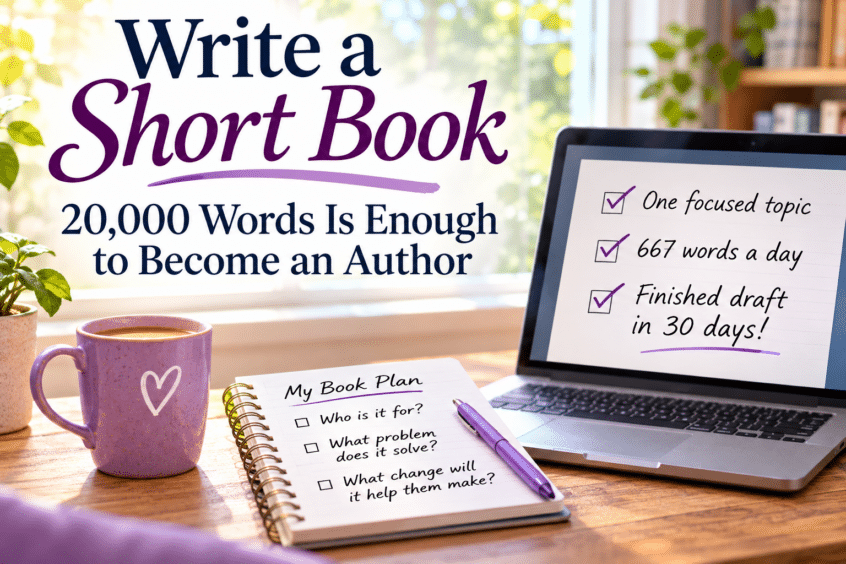
Before you write a single chapter, answer these three questions:
1. Who is this book for?
Be specific. Don’t try to write for everyone. Picture one person who needs the information you’re about to share.
2. What problem does this book solve?
Choose one primary problem. Resist the temptation to solve every problem your reader might have.
3. What change will this book help the reader make?
What will your reader understand, accomplish, or do differently after reading your book?
These three decisions will keep your book focused. They’ll also make it easier to choose what belongs in the manuscript—and what doesn’t.
The math: 667 words a day
Here’s where the idea gets exciting.
If you write 667 words a day for 30 days, you’ll have written 20,010 words.
That’s a short book.
667 words isn’t an enormous assignment. It’s a few well-developed paragraphs. It’s a manageable writing session.
For some writers, that’s about 40 minutes of focused writing. For others, it might take an hour or more. The point isn’t how quickly you type. It’s that the daily assignment is manageable.
You don’t have to find an entire day to write. You don’t have to wait for a week of uninterrupted time. You need to show up consistently and make progress.
Thirty days from now, you could have a complete first draft.
What done looks like
Let’s be clear about what I mean by a finished book.
A 20,000-word first draft isn’t a published book. You’ll still need to revise, edit, proofread, format, and prepare it for publication.
But you’ll have something enormously valuable: a complete manuscript.
You won’t be staring at a blank page or wondering whether you can actually write a book. You’ll have a draft you can work with.
And once that short book is finished, you have something real: a manuscript that can be edited, published, and put into the hands of readers. You’re no longer someone who hopes to write a book. You’re someone who has written one.
Here’s another practical advantage: completion.
Readers who finish your book are much more likely to leave a review than readers who abandon it halfway through. And reviews matter when you’re trying to establish yourself on Amazon. A short, focused book gives readers a better opportunity to experience the complete transformation you promised.
Your book is smaller than you think
You might be surprised by how much you can accomplish in 20,000 words.
You can teach a practical skill. Share a powerful message. Help someone navigate a difficult season. Explain a process. Tell a meaningful story.
You can create something that genuinely helps people without writing a massive book.
And here’s something else to consider: If you have more material than fits in one short book, you might not have a long book. You might have a series.
Instead of overwhelming readers with everything you know, give them one focused book that solves one problem. Then give them another book that solves the next problem. Each book becomes an invitation to continue the journey with you.
You don’t have to write your entire life’s work in one volume.
You just have to start.
Ready to take the next step?
If you’re still struggling to get your book written, I’d like to help you identify what’s getting in the way.
Is it the idea? The plan? The writing itself? Or simply knowing what to do next?
Take my free 90-second quiz, What Kind of Writer Are You? You’ll discover your writing style and get a better sense of what might be keeping you from finishing your book.
Take the free quiz at DonnaPartow.com/quiz.